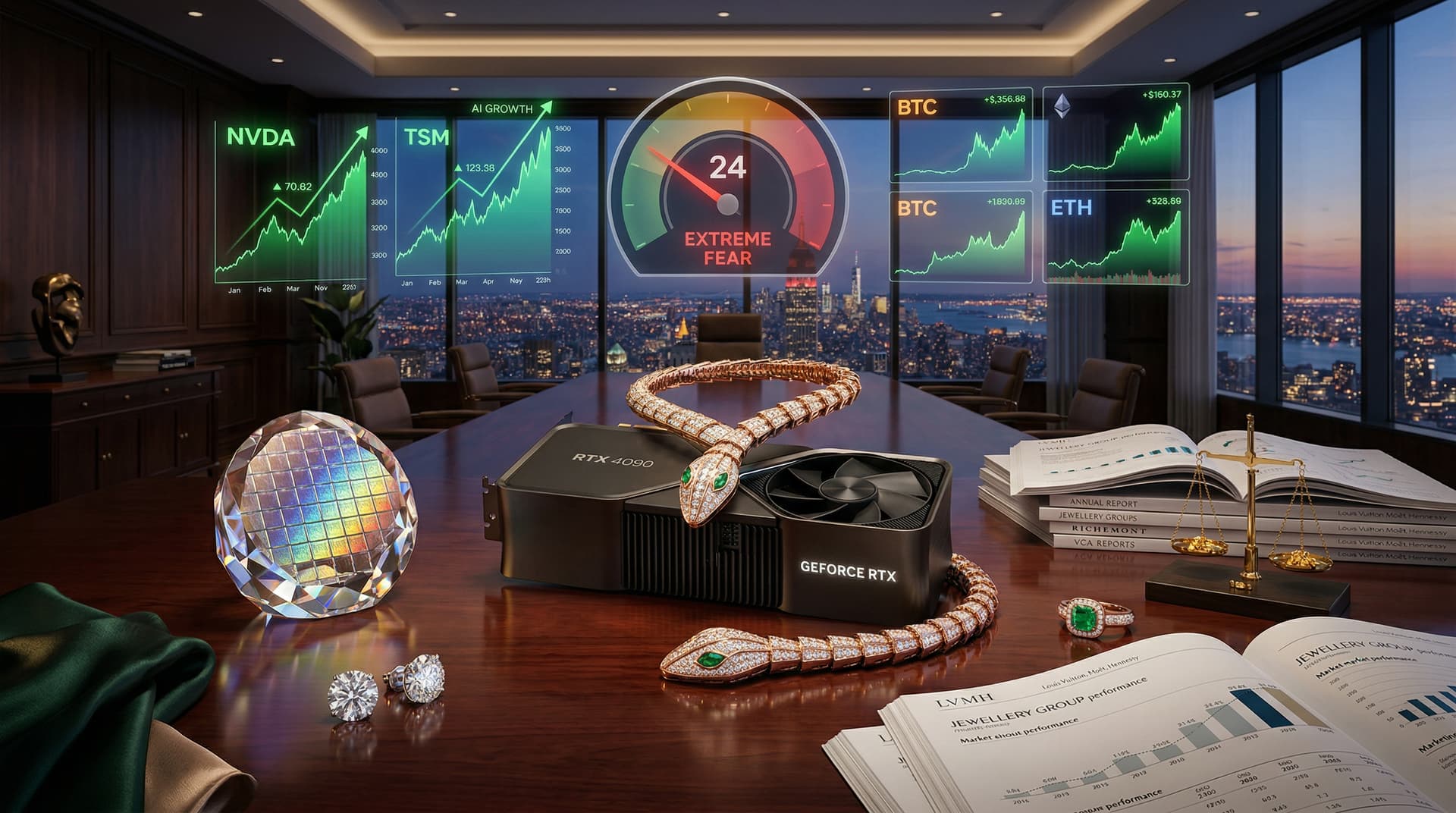
Wedbush analyst Dan Ives named NVIDIA (NVDA) and TSMC AI stocks set for 40% gains by December 31, 2026, on April 10. Luxury investors view these picks as hedges against jewelry sector headwinds.
CNN Money's Fear & Greed Index hit 16 (extreme fear) on April 10, 2026. Bitcoin traded at $73,208 USD, up 1.6%. Ethereum reached $2,254.08 USD, up 1.7%. These signals create AI stock buying opportunities.
Luxury Sector Margin Pressures
LVMH reported €20.5 billion in Q1 2026 revenue on April 8, 2026, flat year-over-year, per company filings. Tiffany and Bulgari jewelry sales grew 2%, trailing overall luxury growth. Richemont posted CHF 4.9 billion in Q3 fiscal 2026 sales on January 17, 2026, with jewelry down 1% at constant exchange rates, per earnings transcripts.
High-end consumers shift spending to tech. AI infrastructure outpaces luxury recovery. LVMH investors (market cap €420 billion as of April 10, 2026) and Richemont investors (€85 billion as of April 10, 2026) seek AI hedges.
| Conglomerate | Q1/Q3 2026 Jewelry Growth | Total Revenue |
|---|---|---|
| LVMH | +2% | €20.5B |
| Richemont | -1% | CHF4.9B |
Data from company reports, April 2026.
NVIDIA: Leading AI Stock
NVIDIA closed at $145 USD on April 9, 2026. Ives sets a $200 USD target by year-end, driven by data center growth. Q4 fiscal 2026 earnings on February 26, 2026, showed $39 billion USD revenue, up 78% year-over-year, per SEC filings.
Gross margins hit 76%. Hyperscalers fuel AI GPU demand. Luxury supply chains deploy NVIDIA GPUs for AI-powered gem grading, per Responsible Jewellery Council reports.
TSMC manufactures NVIDIA's Blackwell chips. Jewelry firms use similar AI for supply chain traceability.
TSMC: Essential AI Foundry Stock
TSMC traded at $185 USD on April 9, 2026. Ives projects $260 USD by December 2026. Q1 2026 revenue reached NT$625 billion per April 18, 2026, guidance (up 35%), per company statements.
3nm nodes power AI chips for Apple and AMD. Richemont tests TSMC-sourced chips in smart jewelry prototypes, per industry reports.
| Stock | Current Price USD | Ives Target USD | Upside |
|---|---|---|---|
| NVDA | 145 | 200 | 38% |
| TSM | 185 | 260 | 41% |
Wedbush note, April 10, 2026.
AI Revolutionizes Jewelry Supply Chains
De Beers deploys AI for diamond sorting. NVIDIA GPUs power computer vision that cuts labor 30%, per Gemological Institute of America 2026 report. TSMC enables edge AI in retail authenticity scanners using GIA grading standards.
Lab-created diamonds claim 25% market share in 2026, per Allied Market Research. AI grading boosts production efficiency. Luxury groups invest $500 million USD in AI traceability, McKinsey March 2026 estimate.
Responsible Jewellery Council integrates AI with blockchain provenance. Richemont pilots TSMC chips for NFT-linked jewels.
Diversification into AI Stocks
LVMH shareholders allocate 15% to tech on average, per Barclays Q1 2026 data. AI stocks show 0.3 beta to luxury indices. Fear & Greed at 16 signals buy opportunities.
Bitcoin at $73,208 USD adds volatility. AI stocks offer steadier upside. Small jewelers adopt NVIDIA tools via startups.
Jewelry Market Outlook
Global jewelry market hits $350 billion USD in 2026, Statista projects. AI delivers $10 billion USD in efficiency gains. Luxury investors shift 20% to AI stocks by 2027, per Goldman Sachs April 5, 2026, report.
China luxury spending recovers to 60% of pre-pandemic levels, Bain & Company states. NVIDIA and TSMC hold 60% AI chip market share, Wedbush estimates.
NVIDIA CEO Jensen Huang stated on April 9, 2026, earnings call: "AI infrastructure spend doubles to $1 trillion USD in 2027."
Tech Boosts Jewelry Retail and Design
Retailers deploy TSMC-powered AR try-ons, boosting conversions 18% in pilots, per trade reports. Lab-created options slash costs 40%.
Designers license NVIDIA CUDA for 3D modeling, cutting costs 25%. Tech adopters seize market share.
Luxury investors balance portfolios with AI stocks now. Growth continues through 2030. Jewelry remains core; tech mitigates risks.