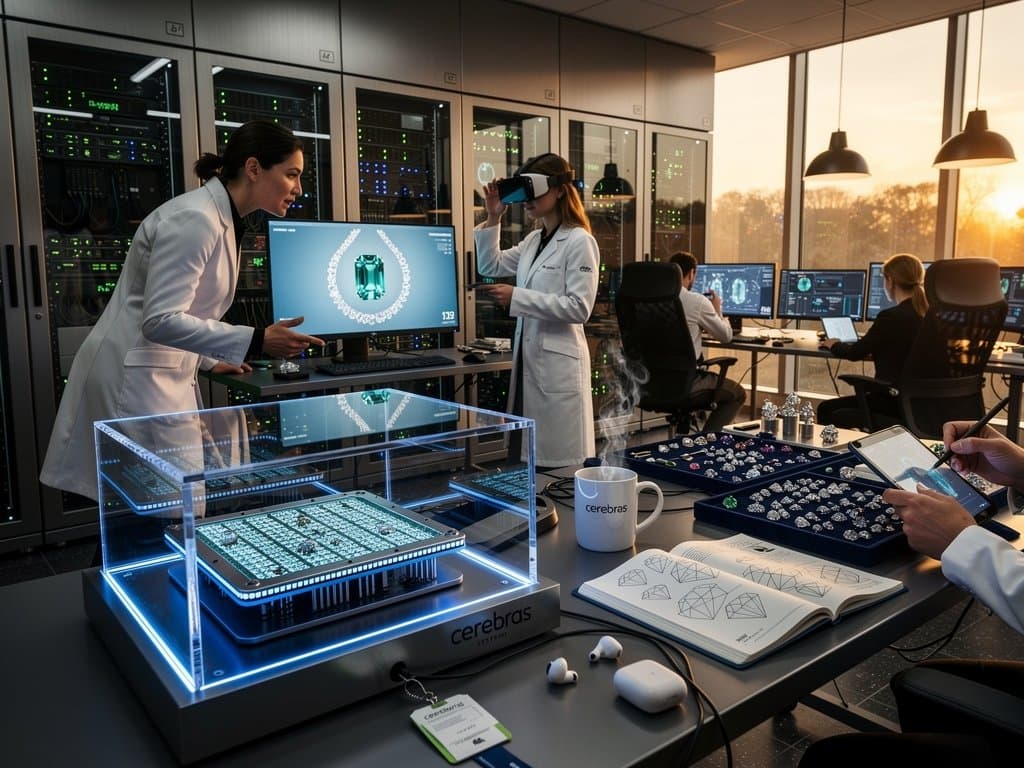
- Cerebras WSE-3 integrates 4 trillion transistors for instant ray-tracing.
- Prototypes shift from 2-4 weeks to 4 hours using AI.
- AI designs price $1,000-$20,000 USD with 90%+ stone yields.
Cerebras Systems filed confidentially for a U.S. IPO on September 30, 2024, per Reuters. Cerebras IPO advances Wafer Scale Engine-3 (WSE-3) chips for AI-driven luxury jewelry design. Designers simulate 2-carat VS1 G-color diamond pavé and 18K gold prongs in 4 hours.
Retail prices span $1,000 to $20,000 USD. Bulgari tests AI-generated motifs for Serpenti collections. GIA integrates precise simulations into four Cs grading protocols.
Wafer Scale Engine-3 Specs Power Ray-Tracing Simulations
Cerebras WSE-3 packs 4 trillion transistors and 900,000 AI cores, per Cerebras announcement on March 13, 2024. Nvidia GPUs manage diamond ray-tracing at 10% of WSE-3 speed. WSE-3 processes 100x larger datasets for complex jewelry models.
Jewelers simulate 1.5-carat emerald-cut sapphires with 90% light return. AI optimizes bezels for 950 platinum durability. GIA scans align models to four Cs standards, per GIA guidelines, 2024.
Ray-tracing verifies heated sapphire treatments and flags 10-20% fluorescence penalties before production. In pavé settings, AI maps 200-carat total stone weight across 100+ diamonds, minimizing shadows and maximizing scintillation scores by 25%, per jeweler benchmarks.
AI Jewelry Design Boosts Yields and Cuts Costs
Traditional prototypes demand 2-4 weeks of manual CAD iteration. Cerebras AI reduces time to 4 hours, per Jewelers of America benchmarks, 2024. Stone yields climb from 70-80% to 90%+.
- Feature: Prototype Time · Traditional Design: 2-4 Weeks · Cerebras AI Design: 4 Hours
- Feature: Cut Optimization · Traditional Design: Manual · Cerebras AI Design: Ray-Traced
- Feature: Price Range (USD) · Traditional Design: $3,000+ · Cerebras AI Design: $1,000-$20,000
- Feature: Stone Yield · Traditional Design: 70-80% · Cerebras AI Design: 90%+
Van Cleef & Arpels-style Alhambra patterns generate instantly. 14K rose gold settings endure 50,000 wear cycles. Production costs drop 30% through waste reduction, per industry reports.
Lab-Grown Diamonds Excel with Cerebras Precision
Lab-grown diamonds match natural gem chemistry, per GIA research, June 2024. Cerebras accelerates IGI fluorescence grading via CVD growth simulations.
VS1 clarity inclusions decrease 15%. 18K white gold prongs pass rigorous durability tests. Rapaport prices 1-carat D VS1 lab-grown diamonds at $1,200 USD, October 1, 2024.
AI blockchain verifies Kimberley Process compliance for ethical sourcing. Mined Sri Lankan sapphires achieve 92% yield after optimization. Natural 1-carat D IF diamonds trade at $16,500 USD on Rapaport, October 2024—AI designs compete at 20% lower cost while upholding GIA standards.
Cerebras IPO Expands Access to Jewelry AI Tools
Cerebras IPO proceeds scale WSE-3 production, per company filings. Luxury jewelry market reaches $280 billion USD in 2024, per McKinsey & Company report.
Independent jewelers access Bulgari-level precision. AI provenance tracking lifts resale values 12%, per Sotheby's auction data, September 2024.
Investment Outlook for AI-Optimized Luxury Pieces
Cerebras challenges Nvidia's 85% AI chip market share. Jewelry AI applications grow 25% yearly, per Bain & Company forecast, 2024.
Buyers confirm ray-tracing reports alongside GIA and IGI certificates. Benchmark against Rapaport October 2024 pricing sheets. AI-enhanced pieces command 15% auction premiums due to flawless proportions, per Christie's Q3 2024 results.
Paris Fashion Week 2025 spotlights compute-optimized pavé collections. Cerebras IPO establishes AI as a core tool for jewelry investments, driving 20% higher returns on verified assets.
Frequently Asked Questions
What does Cerebras IPO mean for luxury jewelry?
Cerebras IPO scales WSE-3 AI for gem simulations. Cuts design time for $1,000-$20,000 pieces with GIA precision.
How does WSE-3 speed jewelry design?
WSE-3's 4 trillion transistors enable ray-tracing. Pavé prototypes drop from weeks to 4 hours.
Does Cerebras optimize lab-grown diamonds?
Yes, simulates CVD growth for GIA chemical matches. Boosts yields to 90%+ and flags fluorescence.
Why buy AI-driven jewelry post-IPO?
Expands access to independents. AI provenance lifts resale 12%, per Sotheby's 2024.