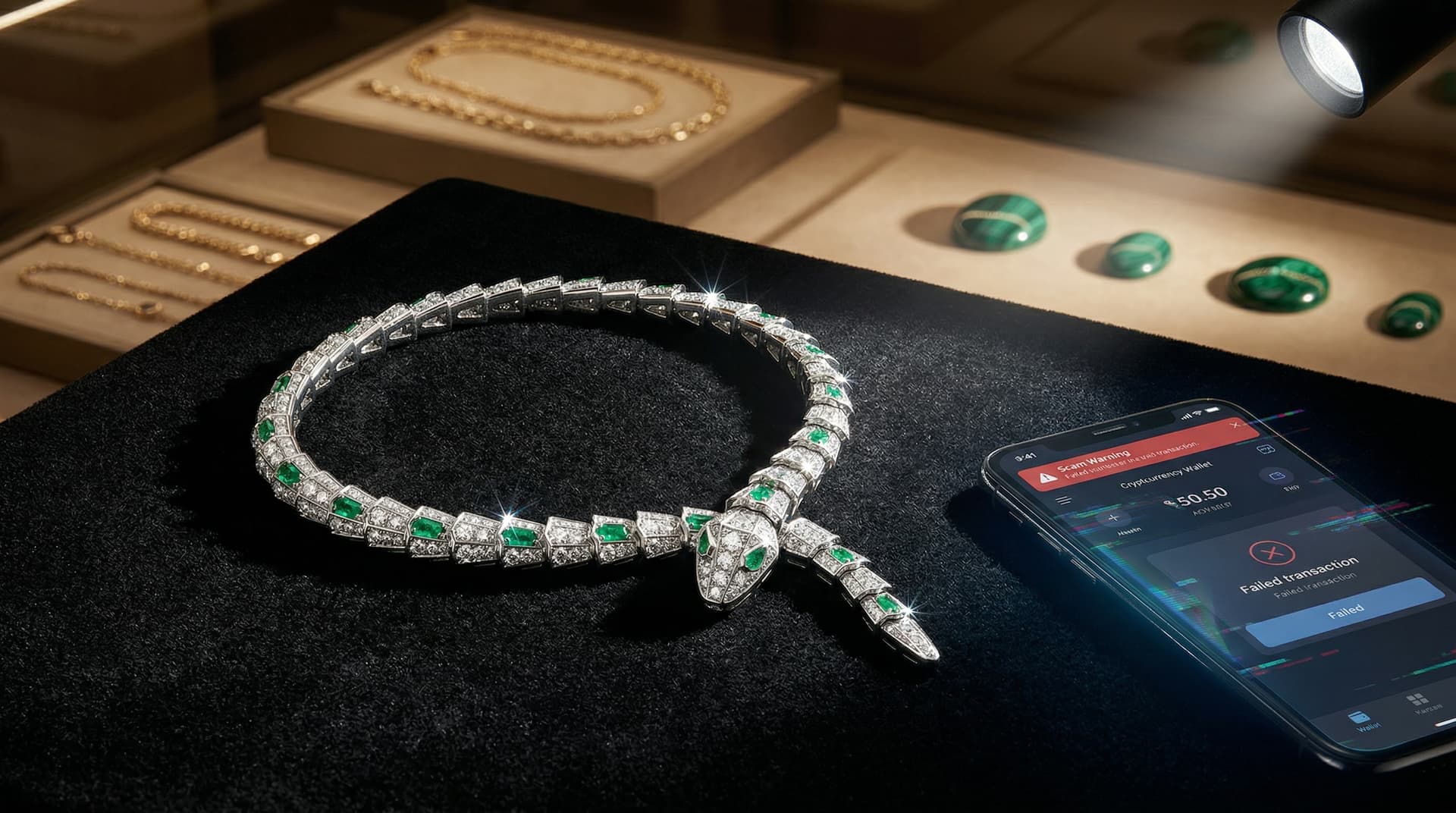
B.C. police report scammers defrauded a luxury necklace buyer of $11,900 USD through a fake Bulgari Serpenti Bitcoin deal on April 12, 2026. The fraudster offered an 18k white gold pavé diamond model at a steep discount. Authorities urge jewelry buyers to verify sellers.
Scammers target high-end online necklace sales. They impersonate trusted platforms and demand crypto payments.
Scam Mechanics in Luxury Necklaces
Fraudsters build fake profiles on OpenSea and jewelry forums. They use stolen images of Van Cleef & Arpels Alhambra 18k yellow gold necklaces with malachite cabochons (retail $15,000 USD). Victims send ETH or BTC to scammer wallets.
Scammers vanish post-payment. Blockchain transactions remain irreversible absent recovery tools. Chainalysis reported a 35% increase in crypto jewelry scams in Q1 2026 (April 10 report).
Deepfake videos depict unboxing pavé-set natural diamonds (GIA VS clarity, 1-2 ct). AI chatbots create urgency during crypto dips.
Crypto Volatility Fuels Necklace Fraud
Bitcoin hit $71,628 USD, down 1.7% on April 12, 2026 (CoinMarketCap). Ethereum dropped 1.4% to $2,215.84 USD. The Fear & Greed Index reached 16 (alternative.me).
Volatility drives fake deals on lab-grown diamond necklaces. Prices fell 20% year-over-year (GIA Gem Market Report, March 2026). Scammers tout 50% discounts on 18k white gold Cartier Love necklaces ($4,500 USD retail).
MetaMask integrations with e-commerce expose buyers. BNB fell 2.1% to $594.43 USD (CoinMarketCap).
Trends Scammers Exploit in Necklaces
Chunky chain necklaces lead spring 2026 runways. Gucci showcased layered 18k gold Byzantine chains at Milan Fashion Week (February 28, 2026). Scammers edit replicas into listings.
Pendant necklaces feature oversized emeralds (oiled, 1+ ct, VVS-VS clarity). Chloé presented bezel-set designs in Paris (March 5, 2026). Fakes sell for $2,500 USD against $8,000 USD authentic prices.
Pandora lab-grown ruby (corundum, hydrothermal) necklaces retail $500-$1,200 USD. Scammers peddle "certified" versions for $300 USD in USDT (pegged $1.00 USD).
Spot Fakes: Jewelry Fraud Prevention Guide
Bulgari Serpenti Viper (18k gold, heated emeralds, GIA certified) starts at $25,000 USD. Verify via brand apps and Everledger blockchain provenance.
Mejuri gold chains (14k-18k solid) range $400-$900 USD. Confirm serial numbers on official sites. Reject DM-initiated deals.
BaubleBar trendy pieces cost $50-$200 USD. Use verified platforms; refuse crypto payments.
Tiffany Lock necklaces include NFC chips (April 2026 launch) for ledger access. Richemont allocated $500 million USD to blockchain (Q1 2026 earnings, April 8).
Lessons from B.C. Crypto Necklace Scam
The victim targeted a vintage 18k Bulgari Serpenti necklace at $11,900 USD. The seller insisted on BTC amid a 5% price dip. RCMP deployed Elliptic analytics to trace wallets.
Crypto anonymity powers scams. USDT jewelry fraud climbed 15% (Chainalysis Q1 2026). Signet Jewelers banned crypto payments after 12% fraud rise in 2025.
BTC at $71,628 USD echoed 2022 lows (TradingView data). View crypto jewelry buys as final transactions.
Protect Purchases with Blockchain Security
Request video inspections of prong settings, hallmarks, and engravings. Opt for Escrow.com ($100 USD fee).
Etherscan checks reveal wallet age; fresh wallets flag risks. Insist on GIA reports for diamonds over 1 ct.
JewelTrace apps read QR codes for provenance. LVMH pilots them for Louis Vuitton jewelry (2026 rollout).
Crypto Scams Persist in Necklace Markets
Versace accepts ETH for Medusa necklaces (Q2 2026 launch). Scams migrate to Web3 marketplaces.
RCMP predicts 40% case increase in 2026. Multi-factor authentication spreads. Digital twins outpace counterfeits.
Investment-grade Cartier Trinity (18k tri-color gold, $5,000-$10,000 USD) retains 8-12% annual appreciation (Rapaport Jewelry Index, Q1 2026). Anabela Chan NFTs blend gems with blockchain. Secure sales demand provenance tech.